Public Lecture: A Meaningful Rule of Law Requires Truth, Power-Sharing, and Justice – Insights from Prof. Paul Butler
By Stella Nannozi and Adam Nuwamanya
What is the Rule of Law? How is it built—and by whom? These were the central questions addressed by Prof. Paul Butler during a compelling public lecture to over 200 members of the Uganda Law Society (ULS) on the morning of June 20. Using the Trump administration as a lens, Prof. Butler illustrated the fragility of the Rule of Law even in countries traditionally viewed as strongholds of democracy.
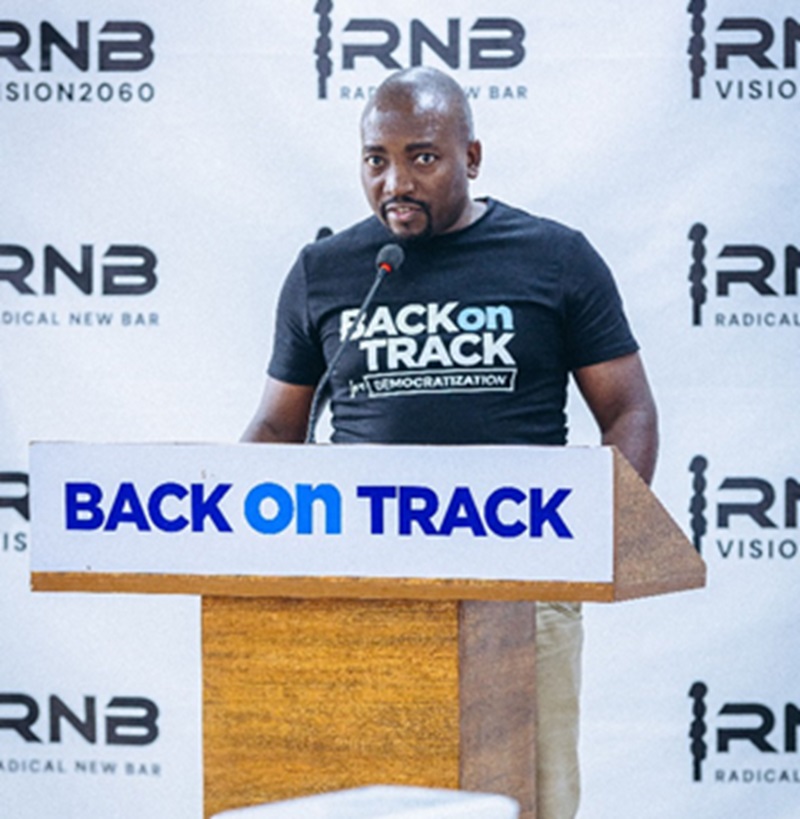
Prof. Butler, a distinguished scholar and Professor of Law at Georgetown University, delivered his lecture at ULS House in Kololo, Kampala City, and to an online audience. The event was organized by the RNB leadership of the Uganda Law Society under the stewardship of President Isaac Ssemakadde, SC.
In his address, Butler argued that the American political landscape is currently plagued by racism, the legacy of “Trumpism,” and the illusion of a fully functioning democracy. According to him, these elements expose deep cracks in the U.S. legal and political systems, particularly in their treatment of Black communities.
“The failures of the Rule of Law and democracy in the United States are glaring when viewed through the lens of Black experience,” said Butler. “When Donald Trump attacks immigrants, Muslims, and Black communities—or calls for ‘law and order’ in ways that disproportionately harm people of colour—he isn’t creating a new political doctrine. He is reviving a very old one.”
Butler emphasized that while the Rule of Law is often celebrated as a cornerstone of American democracy, it has historically served as a tool of oppression for marginalized groups—particularly Black Americans. He pointed to the “trial penalty” as one such example, a phenomenon that pressures many, especially poor and Black defendants, to plead guilty regardless of their actual innocence.
“So those American courtroom dramas you see in movies—filled with dramatic jury trials, surprise witnesses, and passionate closing arguments—they’re not exactly a myth, but they’re not the norm either. In reality, most justice in the U.S. happens quietly, behind closed doors, through negotiation,” said Prof. Butler.
“The United States has the oldest written constitution still in use today. While this is often a source of national pride, we must reckon with the reality that it was deliberately crafted to preserve slavery,” he said. “Consider clauses like the Importation Clause under Article I, Section 9, Clause 1 of the U.S Constitution, the Three-Fifths Compromise, and the Fugitive Slave Clause under Article IV, Section 2, Clause 3 of the U.S. Constitution—all of which legitimized and protected the institution of slavery at the nation’s founding.”
The professor argued that the law continues to fail Black Americans, who remain subjected to police brutality, mass incarceration, and voter suppression.
“On paper, we are equal—but not in practice. And that’s why any conversation about the rule of law in the U.S.—and any honest conversation about Donald Trump—has to include a conversation about race, power, and history,” he asserted.
In conclusion, Prof. Butler made a powerful call to action: for the Rule of Law to be truly meaningful, it must be rebuilt—not merely with new rhetoric, but with truth, equitable power-sharing, and genuine justice.
Prof. Butler can be accessed on various channels including Georgetown Law, his official X (twitter handle) @LawProfButler
Related Posts